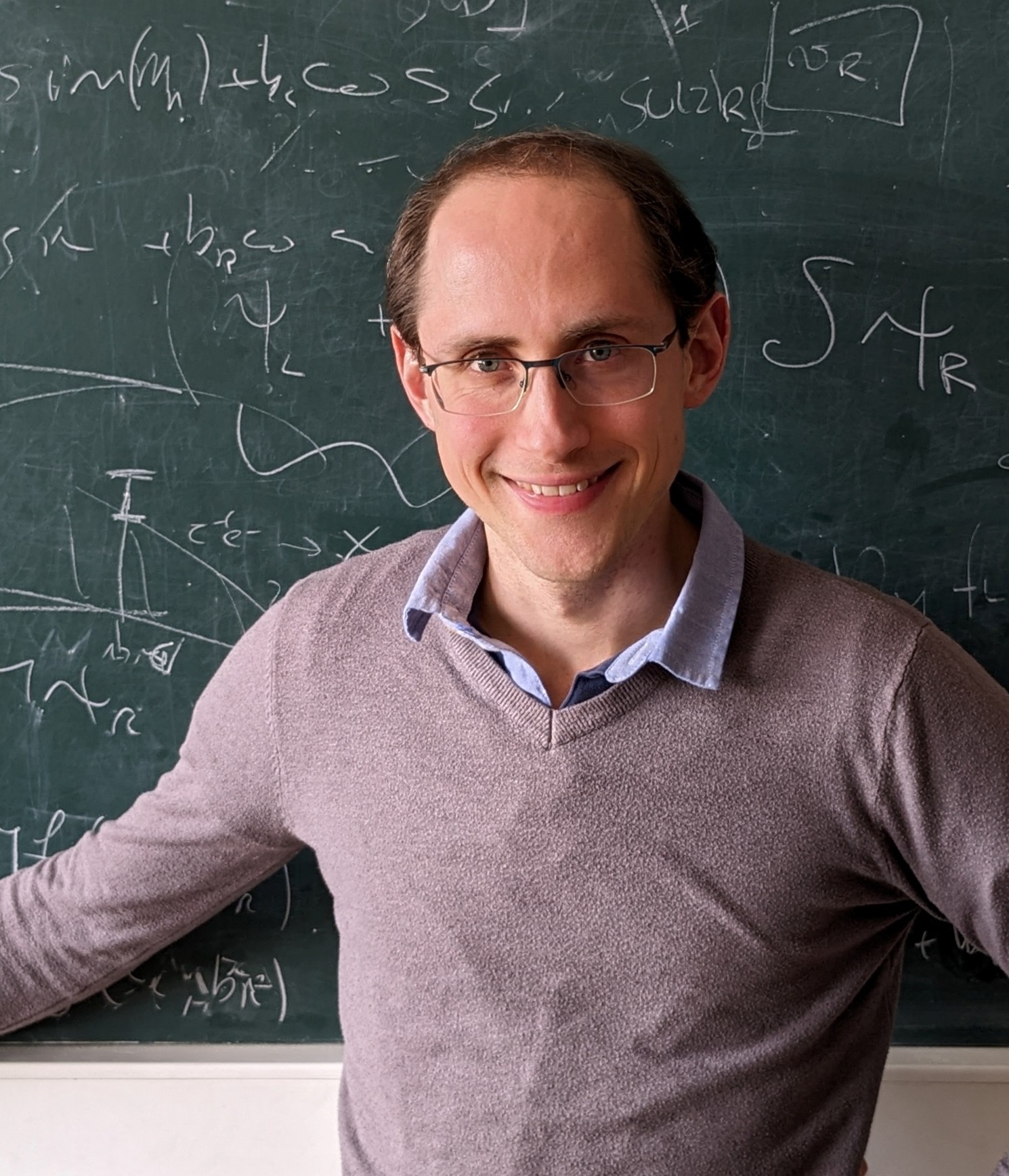
Luc Darme

Luc Darme

I answer to l.darme@ip2i.in2p3.fr as quickly as possible. Or you can find me in Lyon at IP2I, building Dirac, room 337.

My Research

You can find here the articles I have been happy to co-author. For further information about my work, you can see my publication record on InSPIRE.

Selected papers -- by scientific research axis

New light particles at accelerators

Exploring the many ways light new particles could be produced at accelerator facilities.

  • Production of Dark Sector Particles via Resonant Positron Annihilation on Atomic Electrons Phys.Rev.Lett. 132 (2024) 26, 261801, ArXiv: 2403.15387 [hep-ph] : with Fernando Arias-Aragon, Giovanni Grilli di Cortona and Enrico Nardi
    This work opened a previously unexplored direction of research by showing that NP production in positron fixed target experiments can proceed at a energies more than twice higher than previously thought. By leveraging the quantum delocalisation in atoms, electrons with momenta extraordinarily larger than their bounding energy can be obtained, although with a tiny probability. I designed the core of the theoretical framework and led the study of the relativistic regime on which our current work now focuses
  • UFO 2.0: the ‘Universal Feynman Output’ format (Eur.Phys.J.C 83 (2023) 7, 631) : with several other authors.
    A large-scale effort [60] with around twenty authors of Monte-Carlo simulation codes to provide a more versatile input format for models of NP. I used this opportunity to include in the framework an improved flexibility in the treatment of NP interactions with matter that will be required for the simulation of in-matter production.
  • Shedding light on X17: community report (Eur.Phys.J.C 83 (2023) 3, 230) : with several other authors.
    In link with my previous papers, I was responsible for the general review of the existing searches strategies for a 17 MeV experimental anomaly that could be caused by the presence to a light NP.
  • Resonant search for the X17 boson at PADME Phys.Rev.D 106 (2022) 11, 115036 with Marco Mancini , Enrico Nardi and Mauro Raggi
    We discuss the experimental reach of the Frascati PADME experiment in searching for new light bosons via their resonant production in positron annihilation on fixed target atomic electrons. A scan in the mass range around 17 MeV will thoroughly probe the particle physics interpretation of the anomaly observed by the ATOMKI nuclear physics experiment. In particular, for the case of a spin-1 boson, the viable parameter space can be fully covered in a few months of data taking.
  • New production channels for light dark matter in hadronic showers (Phys. Rev. D 102, 2020): with Andrea Celentano, Luca Marsicano, Enrico Nardi Hadronic showers transfer a relevant amount of their energy to electromagnetic subshowers. We show that the generation of “secondary” dark photons in these subshowers is significant and typically dominates the production at low dark photon masses. The resulting dark photons are however substantially less energetic than the ones originating from mesons decay. We illustrate this point both semianalytically and through Monte Carlo simulations. Existing limits on vector-mediator scenarios for light dark matter are updated with the inclusion of the new production processes.
Models and phenomenology of flavour

Creating new insights into the old problem of the origin of the different fermionic generations and their masses

  • Gauge SU(2) flavour transfers JHEP 05 (2024) 313, JHEP 05 (2024) 313 : with Aldo Deandrea and Farvah Mahmoudi
    I have shown in this work that new horizontal gauge symmetries (acting on flavour generation indices) lead easily to NP showing a specific experimental feature I named “flavour transfer process”. I identified these features and fully quantified them. I then suggested adapted search strategies at LHC.
  • The axion flavour connection (JHEP 02 (2023), 201, ArXiv: 2211.05796 [hep-ph]): with Enrico Nardi and Clemente Smarra
    A local flavour symmetry acting on the quarks of the Standard Model can automatically give rise to an accidental global U(1)U(1) which remains preserved from sources of explicit breaking up to a large operator dimension, while it gets spontaneously broken together with the flavour symmetry. Such non-fundamental symmetries are often endowed with a mixed QCD anomaly, so that the strong CP problem is automatically solved via the axion mechanism. We illustrate the general features required to realise this scenario, and we discuss a simple construction based on the flavour group SU(3)×SU(2)×U(1)FSU(3)×SU(2)×U(1)F​ to illustrate how mass hierarchies can arise while ensuring at the same time a high quality Peccei-Quinn symmetry.
  • Flavour anomalies and the muon g − 2 from feebly interacting particles (JHEP03, 2022): with Marco Fedele, Kamila Kowalska, Enrico Sessolo
    We perform a phenomenological analysis of simplified models of light, feebly interacting particles (FIPs) that can provide a combined explanation of the anomalies in b → sll transitions at LHCb and the anomalous magnetic moment of the muon. Different scenarios are categorised according to the explicit momentum dependence of the FIP coupling to the b−s and μ−μ vector currents and they are subject to several constraints from flavour and precision physics. We show that viable combined solutions to the muon g − 2 and flavour anomalies exist with the exchange of a vector FIP with mass larger than 4 GeV. Interestingly, the LHC has the potential to probe this region of the parameter space by increasing the precision of the Z → 4μ cross-section measurement. Conversely, we find that solutions based on the exchange of a lighter vector, in the GeV range, are essentially excluded by a combination of B to K+ invisible and W-decay precision bounds.
  • Flavour anomalies from a split dark sector (JHEP08 2020): with Marco Fedele, Kamila Kowalska, and Enrico Sessolo. We show that the set of flavor anomalies observed in kaonic B-meson decays can point to new GeV scale neutral particles in certain new physics extension of the Standard Model, and study in details their signatures in various experiments.
Phase Transitions and gravitational waves

Studying the dynamics of phase transitions in the early universe and their possible experimental consequences

Muon magnetic moment

Exploring the theory and the experimental side of one of the longest-standing anomaly in particle physics

Dark sectors and light dark matter

Tackling the issue of the origin and nature of dark matter, one new light particle at a time

  • Atmospheric resonant production for light dark sectors (Phys.Rev.D 106, 2022):
    Cosmic ray atmospheric showers provide an effective environment for the production of MeV-scale dark sector particles. We show that, when available, the resonant annihilation of positrons from the shower on atmospheric electrons is the dominant production mechanism by more than an order of magnitude. We provide a quantitative example based on dark photon production and update existing constraints on a corresponding light dark matter model from kilotons neutrino experiments and xenon-based direct detection experiments.
  • Inelastic dark matter at the Fermilab Short Baseline Neutrino Program (Phys.Rev.D 104, 2021): with Brian Batell, Joshua Berger and Claudia Frugiuele
    We study the sensitivity of the Fermilab Short-Baseline Neutrino (SBN) experiments, MicroBooNE, ICARUS, and SBND, to MeV- to GeV-scale inelastic dark matter interacting through a dark photon mediator. These models provide interesting scenarios of light thermal dark matter, which, while challenging to probe with direct and indirect detection experiments, are amenable to accelerator-based searches. We consider production of the dark sector states with both the Fermilab Booster 8 GeV and NuMI 120 GeV proton beams and study the signatures of scattering and decay of the heavy excited dark state in the SBN detectors. These distinct signatures probe complementary regions of parameter space. All three experiments will be able to cover new ground, with an excellent near-term opportunity to search for cosmologically motivated targets explaining the observed dark matter abundance.
  • Selective enhancement of the QCD axion couplings (Phys.Rev.D 103, 2021): with Luca Di Luzio, Maurizio Giannotti, Enrico Nardi.
    We present a mechanism wherein the QCD axion coupling to nucleons, photons, or electrons can be enhanced selectively without increasing the axion mass. We focus in particular on the axion-nucleon couplings that are generally considered to be largely model independent, and we show how nucleophilic axion models can be constructed. We discuss the implications of a nucleophilic axion for astrophysics, cosmology, and laboratory searches. We present a model with enhanced axion couplings to nucleons and photons that can provide an excellent fit to the anomalous emission of hard x-rays recently observed from a group of nearby neutron stars, and we argue that such a scenario can be thoroughly tested in forthcoming axion-search experiments.
  • Light Dark Sectors through the Fermion Portal (JHEP07 2020): with Sebastian Ellis and Tevong You. Light new dark sector communicates with the Standard Model via so-called "portal operators". We present in this work an effective portal, suited to describe the setup where the new dark sector interacts with the Standard Model via heavy new particles (typically at the TeV scale or above)
  • Forbidden frozen-in dark matter (JHEP 1911): with Andrzej Hryczuk, Dimitris Karamitros and Leszek Roszkowski. We present a new mechanism to generate the dark matter density via freeze-in, based on the thermal mass generated by the high temperature in the early universe.
  • Signatures of dark Higgs boson in light fermionic dark matter scenarios (JHEP 1812): with Soumya Rao and Leszek Roszkowski. An extension of our previous paper on the same topic, examining in more details the semi-visible 3-body signatures which often characterise such scenarios.
  • Light dark Higgs boson in minimal sub-GeV dark matter scenarios (JHEP 1803): with Soumya Rao and Leszek Roszkowski. We explore two minimal and self-consistent models with a light Dark matter candidate.
  • (O)mega Split (JHEP 1511): with Karim Benakli, and Mark Goodsell. We further develop the Fake Split SUSY models we have considered in our previous paper, studying in particular their cosmology.
Searching for new physics at LHC

Testing new models at the highest energy collider available, with a focus on top-quark physics

Formal works

From supergravity to extended gravity models

Talks

Some of the presentations that I gave recently and a rought selection of my older talks:

  • 2th December 2024 Science at the Luminosity Frontier: Jefferson Lab at 22 GeV, invited talk “Overview of sub-GeV Physics in the Dark sector”
  • 7th July 2024: KIT seminar "Resonant dark sector production on atomic electrons”
  • 7th June 2024: LIO International Conference on "Asymptotic safety in Quantum Field Theory: Grand Unification" (Lyon), invited talk, “Musings on horizontal gauge symmetries”
  • 24th January 2024: RPP 2024 (Paris), invited talk, “Horizontal gauge symmetries and flavour transfers”
  • 22nd June 2023: KIT seminar "The muon g-2 window discrepancy and GeV scale new physics”
  • 2d June 2023: FPCP 2023, invited review talk “Dark matter and flavour”
  • 7th February 2023: KIAS (Corée du sud), invited seminar, “The muon g-2 window discrepancy and GeV-scale new physics”
  • 3th March 2023: LPC Clermont-Ferrand, seminar, “The muon g-2 window discrepancy and GeV-scale new physics”
  • 7th November 2022: LHCTop WG, invited talk , “The 4-top-quark BSM potential: resonant and non-resonant opportunities”
  • 4th November 2022: GDR Intensity Frontier, “Feebly Interacting Particle searches with positrons”
  • 20th October 2022: FIP 2022 , “Resonant FIP searches with positrons”
  • 2nd September 2022: LFC22, invited talk , “A tale of two frontiers: low energy accelerators for high-energy physics”
  • 8th July 2022: ICHEP 2022, “The muon g-2 and GeV-scale new physics”
  • 22th June 2022: LIO, invited talk, “Feebly Interacting Particles from cosmic rays showers”
  • 13th April 2022: Subatech Nantes, seminar, “Feebly Interacting Particles and B anomalies”
  • 1st April 2022: IP2I Lyon, seminar, “Feebly-Interacting Particles”
  • 31th March 2022: ICCUB Barcelone, seminar, “The muon g-2 anomaly and GeV-scale new physics”
  • 13th January 2022: LAPTh Annecy, seminar, “Flavourful vector FIPs for B → K and g-2 anomalies”
  • 16th November 2021: GDR Intensity Frontier, LPNHE, “Feebly-Interacting Particles and g-2 anomalies”
  • 21th October 2021: JRJC, invited talk, “Theory session overview”
  • 8th October 2021: LPSC Grenoble, seminar , “Feebly-Interacting Particles and g-2 anomalies”
  • 4th June 2021: g- 2 days, (Fully Remote), invited talk, “Constraints on “invisible” Feebly- Interacting Particles and g-2 anomalies”
  • 25th May 2021: PHENO2021 “ Flavourful vector FIPs for B → K and g-2 anomalies”
  • 5th May 2021: LPSC Grenoble, Seminar , “Four-top-quark signatures: from EFT to simplified models”
  • 13th January 2021: LNF Frascati, Fundamental Physics in Frascati (FFF) , “Potential reach for Dark Photons and ALPs with improved e+/e− beam”
  • 2th November 2020: IP2I Lyon, Tools 2020, “Tools for Feebly Interacting Particles”
  • 5th June 2020: Dark Matter @ LHC 2020, “Dark photons from hadronic showers”
  • Mars 2020: IJCLab Orsay, seminar "Light and flavoured dark sectors through the fermion portal"
  • Jan 2020: Ecole Polytechnique, RPP 2020 "Light dark sector EFT and long-lived states"
  • Dec 2019: LUPM Montpellier, seminar "The fermion portal: a dark sector EFT"
  • Dec 2019: Rome 3, seminar " Light dark matter, dark sector EFT and long-lived states"
  • Nov 2019: Light Dark Matter @ Accelerators 2019 "Light dark matter, dark sector EFT and long-lived states"
  • June 2019: seminars, Warsaw University, LNF Frascati. "Searching for long-lived particles from light dark sectors"
  • Mai 2019: invited talk , PAP 2019, Warsaw "Searching for long-lived particles from light dark sectors"
  • Jan 2018: LPC Clermont, RPP 2019 "Hunting light dark sectors in sub-GeV dark matter scenarios"
  • Nov-Dec. 2018: seminars in King's college London, University of Cambridge DAMPT/Cavendish laboratory, THEP Mainz, LPSC Grenoble, LAPTh Annecy, IPNL Lyon, LPT Orsay "Hunting light dark sectors in sub-GeV dark matter scenarios"
  • Oct. 2018: invited talk , Symposium "The puzzle of dark matter - assembling the pieces", DESY: "Dark sectors with sub-GeV dark matter"
  • Mai 2018: PLANCK 2018, Bonn: "Hunting light dark sectors in sub-GeV dark matter scenarios"
  • Mai 2018, CERN workshop (Re)interpreting the results of new physics searches at the LHC: "Recasting four top quarks searches: the sgluon case"
  • Mai 2018, seminar, Institute for Theoretical Particle Physics and Cosmology, Aachen: "Hunting light dark sectors in sub-GeV dark matter scenarios"
  • Mars 2018, invited talk , Moriond QCD 2018, La Thuile: "Light dark sector at colliders and fixed target experiments"
  • September 2017, invited talk , Polish Particle Astrophysics conference, Krakow: "Dark matter,on and off the beaten track"
  • September 2017: invited talk , 44ZFP (Polish Science Society), Wroclaw: "Dark matter and the high-intensity frontier"
  • May 2017: PLANCK 2017, Warsaw: "The fate of the oscillating false vaccum"
  • June 2016: 28th Rencontres de Blois: "Diphoton excess and perturbative SUSY with Dirac Gauginos"
  • May 2017: PLANCK 2016, Valencia: "Diphoton excess and perturbative SUSY with Dirac Gauginos"
  • May 2016: ITP Heidelberg: "Diphoton excess and perturbative SUSY with Dirac Gaugins"
  • November 2015: GDR Terascale, Grenoble, How high could SUSY go?
  • November 2015: Terascale Alliance, DESY (Hamburg), How high could SUSY go?
  • May 2014: PLANCK 2014, Paris, A Fake Split-Supersymmetry Model for the 126 GeV Higgs
  • February 2014: LPTHE Internal seminar , Introduction to the FSSM and how to "predict" a 126 GeV Higgs